Can Capacitive Touchscreen Manufacturers Make Touch Panels for Self-Service Equipment?

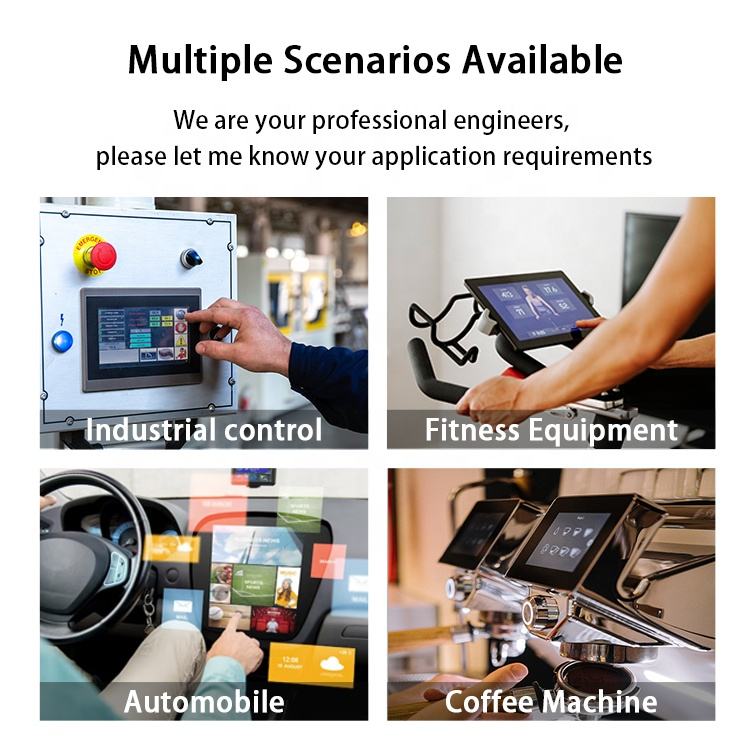
Self-service equipment is now widely used in restaurants, retail stores, banks, hospitals, transportation, industrial facilities and other commercial environments.
Self-ordering kiosks, self-checkout machines, information terminals and other interactive equipment all require reliable human-machine interfaces.
For equipment manufacturers, the touchscreen is an important part of that interface.
But can a capacitive touchscreen manufacturer produce a touch panel specifically for self-service equipment?
Yes. Custom capacitive touch panels can be designed around the mechanical, electrical and environmental requirements of the final equipment.
Why PCAP Touchscreens Are Used in Self-Service Equipment
Self-service equipment often experiences frequent daily operation.
A touchscreen may need to support:
- Fast touch response
- Multi-touch operation
- Accurate touch detection
- Long operating hours
- Different user touch methods
- Glove operation
- Water or fingerprints
- Strong ambient light
- Different temperature conditions
Projected capacitive touch technology, or PCAP, is widely used for interactive equipment because it can support multi-touch operation and customized glass-based touch panel structures.
However, the correct configuration depends on the specific equipment.
G+G Touchscreen Structure for Kiosk Applications
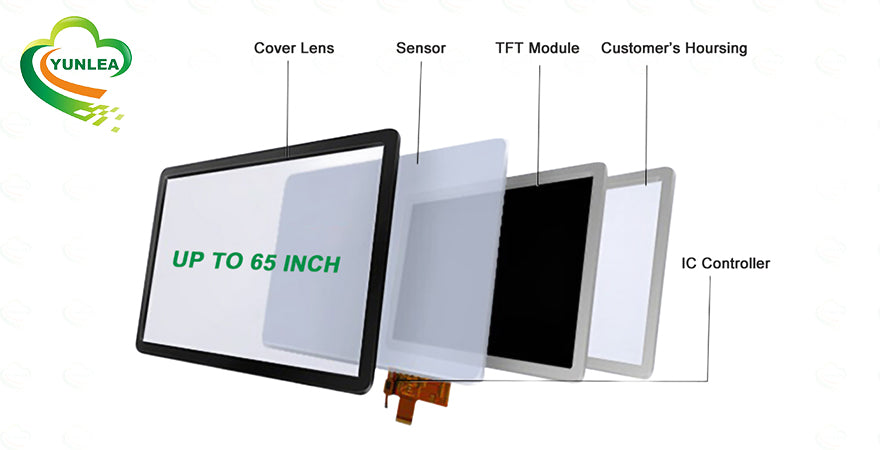
One common PCAP structure is G+G, which means Glass + Glass.
A typical structure consists of:
Cover Glass → Touch Sensor → FPC + Touch IC
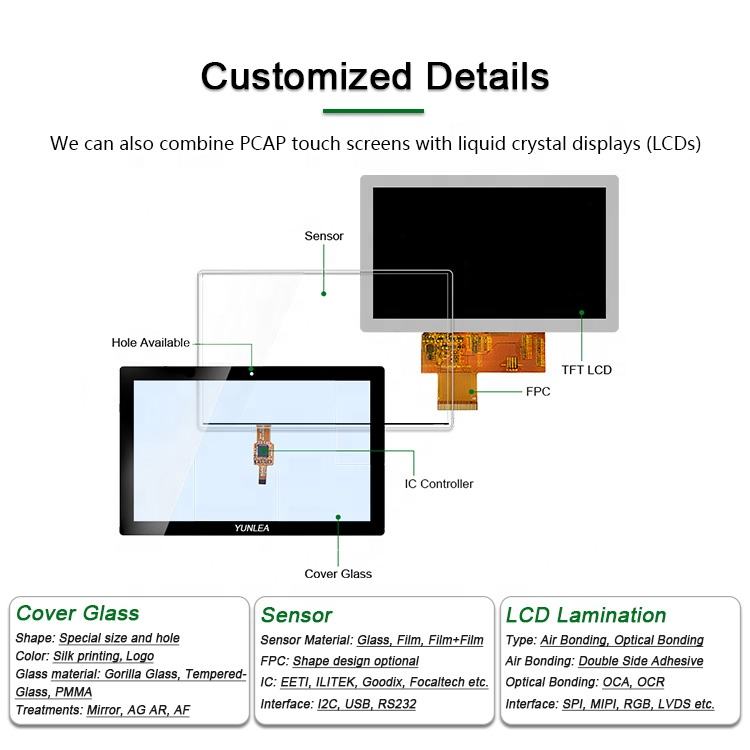
The cover glass provides mechanical protection and can also include customized printing, edge shapes and surface treatments.
The touch sensor detects the user's touch input.
The FPC and touch controller provide the electrical connection between the touch panel and the host system.
G+G can be considered for applications where durability and long-term operation are important.
Custom Cover Glass for Self-Service Equipment
The cover glass is an important part of a customized touchscreen.
Depending on the equipment design, the cover lens may require:
- Custom dimensions
- Different glass thicknesses
- Rounded corners
- Custom shapes
- Cut-outs
- Narrow bezels
- Black or other silk-screen printing
- AG treatment
- AR treatment
- AF treatment
For example, an outdoor kiosk may require better anti-glare or anti-reflection performance, while an indoor self-service terminal may have different priorities.
The right specification should therefore be selected according to the installation environment.
Custom Shapes and Sizes
Self-service equipment does not always use standard rectangular displays.
A customized touch panel may need to match the mechanical housing of the machine.
Possible designs include:
- Rectangular touch panels
- Rounded rectangular panels
- Circular touch panels
- Irregular shapes
- Panels with cut-outs
- Narrow-bezel designs
- Customized silk-screen areas
For OEM manufacturers, this means the touchscreen supplier needs to understand the complete mechanical design rather than simply supplying a standard-size touch panel.

Touch Controller and Interface
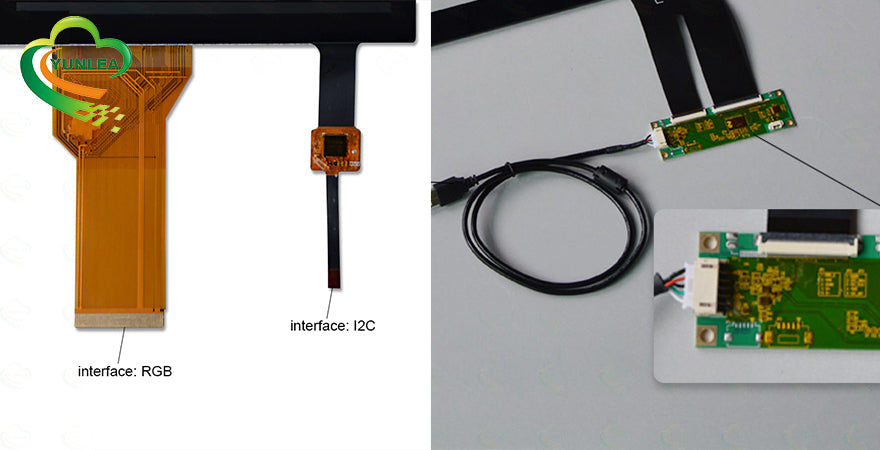
The touch sensor must communicate with the host system.
Depending on the project, common interfaces can include:
- USB
- I2C
- RS232
- UART / TTL
The appropriate interface depends on the mainboard and software architecture of the final equipment.
For an OEM project, confirming the host interface early can simplify sample development and compatibility testing.
Touchscreen Performance for Different Environments
Not all self-service applications require the same touchscreen configuration.
For indoor kiosks, the main priorities may be touch response, accuracy and stability.
For outdoor equipment, additional requirements may include:
- Strong-light performance
- Water resistance
- Glove touch
- Temperature resistance
- Anti-glare performance
Industrial self-service equipment may also require stronger electromagnetic interference resistance and reliable operation with thicker cover glass.
Therefore, touchscreen specifications should always be developed around the actual operating environment.

Air Bonding vs. Optical Bonding
When the touch panel is integrated with a display, manufacturers may also need to select a bonding method.
Air Bonding
Air bonding leaves an air gap between optical components.
It can be suitable for projects where cost and serviceability are important.
Optical Bonding
Optical bonding uses optical adhesive to eliminate the air gap between the relevant layers.
It can help reduce internal reflections and improve optical performance, particularly in bright environments.
The choice depends on the equipment design, optical requirements and project cost.

What Information Should You Send to a Touchscreen Manufacturer?
If you are developing a self-service machine and need a customized touch panel, providing the following information can help the engineering team evaluate the project:
Mechanical Requirements
- Touchscreen size
- Active area
- Overall dimensions
- Shape
- Cut-outs
- Corner radius
- Cover glass thickness
- Silk-screen requirements
Touch Requirements
- Number of touch points
- Finger touch
- Glove touch
- Water touch
- Touch accuracy
- Touch response requirements
Electrical Requirements
- USB
- I2C
- RS232
- UART / TTL
- Touch controller requirements
- FPC requirements
Environmental Requirements
- Indoor or outdoor use
- Operating temperature
- Water exposure
- Strong ambient light
- EMI requirements
Project Information
- Prototype quantity
- Estimated production quantity
- Target application
- Required sample schedule
- Mass-production requirements
The more complete the project information, the easier it is to develop a suitable touchscreen configuration.
Yunlea Custom Touchscreen Solutions
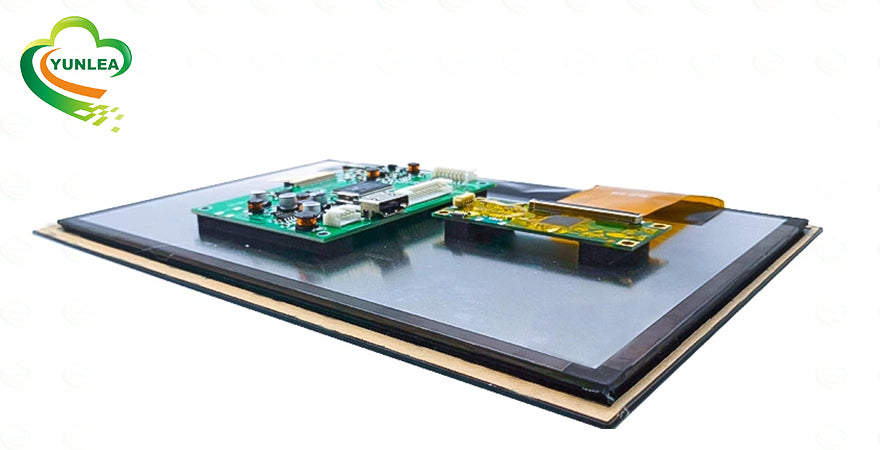
Yunlea / 云立 focuses on customized touch panel projects for OEM and ODM applications.
Depending on the project requirements, customization can involve the touch panel dimensions, shape, cover glass, printing, sensor structure, FPC, touch controller, interface and surface treatment.
For self-service equipment manufacturers, the touchscreen can therefore be developed according to the actual mechanical and electrical requirements of the equipment rather than being limited to a standard off-the-shelf configuration.

Conclusion
A capacitive touchscreen manufacturer can develop touch panels specifically for self-service equipment.
However, a dedicated touchscreen solution involves much more than choosing a screen size.
A complete OEM project may involve:
Size + Touch Structure + Cover Glass + Surface Treatment + Touch IC + FPC + Interface + Touch Tuning + Environmental Requirements
By defining these requirements early, equipment manufacturers can reduce compatibility issues during prototype development and create a touchscreen solution that is better matched to the final machine.
For customized self-service equipment projects, Yunlea / 云立 can evaluate the touchscreen requirements based on the customer's mechanical, electrical and environmental specifications.